
Guide
Indian haveli doors: what they are, how they were made and how to use them
The doors of the havelis of northern and western India combine solid wood, iron and brass fittings and fine carving. How to recognise a good piece, what to check before buying and how to give it a place in a contemporary home.
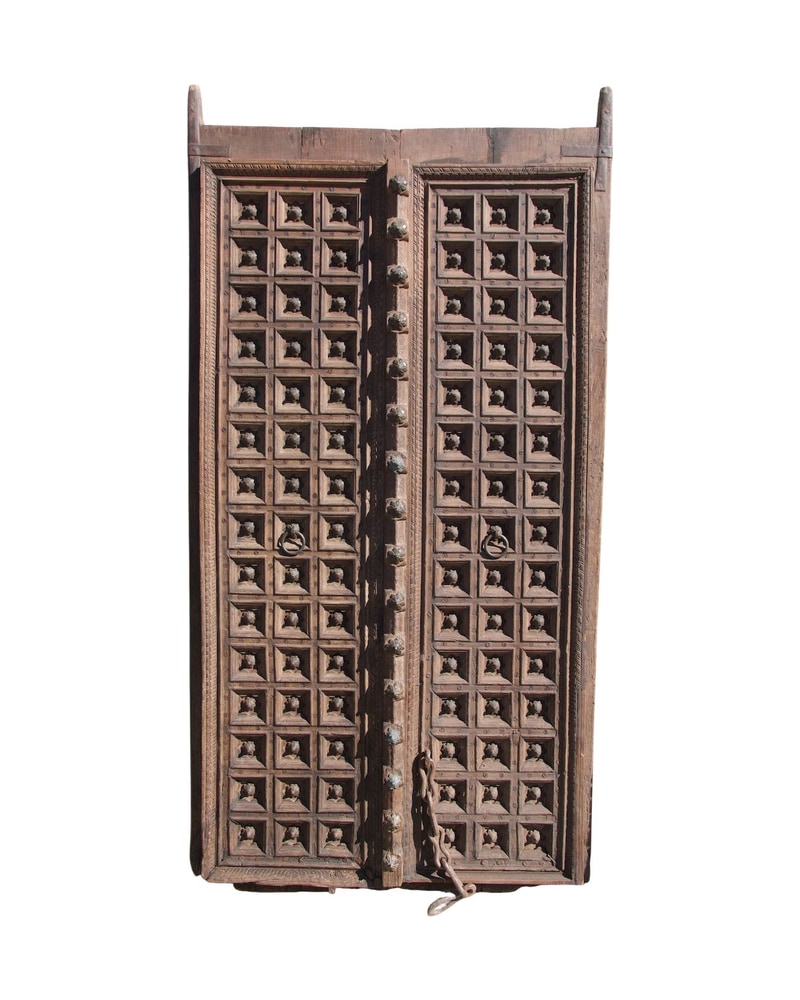
The phrase “haveli door” turns up often in antiques listings. Behind it lies a specific architectural tradition: the urban mansions of northern and western India, whose doors have become some of the most sought-after pieces of architectural salvage among interior designers worldwide. This guide explains where they come from, how they were built and what to look at before buying one.
What a haveli is
A haveli is a traditional house belonging to a well-off family, arranged around one or more inner courtyards. The best known are in Rajasthan and Gujarat, built by merchant families who made their fortunes in trade and wanted to show it on their façades, balconies and, above all, their main door. In some regions, such as Shekhawati, the walls were also covered with murals.
The door was the house’s calling card, so much of the joinery and metalwork is concentrated there: moulded frames, floral and geometric carving, large nails and metal plates and, often, a protective figure on the lintel. Many of these houses were abandoned or remodelled during the twentieth century, and their doors reached the antiques market.
How they are built
Most haveli doors in circulation today are made of solid teak, a dense wood rich in natural oils that resists damp and insects well. Pieces in other local hardwoods also appear. The usual elements are:
- Two leaves hung in a separate frame, sometimes with a heavily worked threshold and lintel.
- Fittings in wrought iron and often brass: hinges, bolts, knockers and closing chains.
- Large-headed nails and bosses and metal plates that reinforce the wood and decorate the surface.
- Carving on the frame and panels, with floral, geometric or figurative motifs.
- On some pieces, a small wicket door cut into one of the leaves, so the whole door did not have to be opened every day.
Some doors keep traces of polychromy, original paint in blues, greens or reds, now worn with time. That patina is part of the piece’s value and should not be removed without good reason.
How to recognise a good piece
The success of these doors has also led to new “haveli-style” doors being made, sometimes from reclaimed timber. They are legitimate objects, but they are not antiques and their price should reflect that. These signs help to tell them apart:
- Logical wear. Rubbing is concentrated where the door was touched: around the knocker, on the edges of the leaves, at the bottom and on the threshold. Uniform wear over the whole surface is usually artificial.
- Consistent fittings. Old nails and hinges are forged, with irregular heads and rust that has stained the surrounding wood. Modern machine screws point to repairs or new work.
- Wood that has moved. Fine cracks following the grain, joints that have opened and closed over the years and hand-tool marks on hidden surfaces.
- Carving with depth. Old work shows the mark of the gouge and small differences between repeated motifs. Machine carving is more uniform and shallower.
- Back and edges. Always look at the inner face and the edges. They are the least retouched parts and tell the piece’s history best.
What to check before buying
A haveli door travels far from the climate it was made for. Before buying, ask the seller, or check in person:
- Full dimensions: height, width and thickness of the leaves and of the frame, separately. Our guide to measuring before you buy will help.
- Condition of the wood: whether there is active woodworm, whether it has been treated and whether the joints are sound.
- Complete fittings: whether the door keeps its hinges, bolts and locks, or whether parts are missing.
- Weight: a solid teak door with its frame can weigh far more than the photo suggests; you need to know for transport and installation.
How to use one in a contemporary home
The most direct use of a haveli door is as an entrance or internal door, fitting a new frame to the existing opening or, better still, keeping the original frame if the building work allows. But it is not the only option:
- Headboard: one leaf or the pair, fixed to the wall, gives a bedroom presence without needing much else.
- Room divider: mounted on a stable base, it separates spaces without closing them off.
- Wall piece: the carved frame works on its own as a sculptural element in a hall or a long corridor.
- Table: in some cases, a leaf protected with glass becomes a coffee table top.
A practical tip: when it arrives, let the wood acclimatise indoors for a few weeks before fitting it precisely. Changes in humidity make solid wood move, and it is better for that to happen before installation than after. For more ideas, read how to integrate antique doors into interior design.
Haveli doors on Antiga
All available Indian doors, with dimensions, detail photos and the option to write directly to the dealer for more information.
See Indian haveli doors →Explore the catalogue
Related pieces

Large 19th Century Haveli Door
Noble Doors of India
19th Century · India
Solid teak wood
Portantica · Madrid
990 €
Haveli Door from India, 19th Century
Doors & Architectural
19th Century · India
Solid teak wood with wrought iron fittings
Portantica · Madrid
990 €
Gran Marco de Entrada Haveli del Siglo XIX
Noble Doors of India
19th Century · India
Solid Acacia Wood (Babul)
Portantica · Madrid
990 €
Noble Door from India, 19th Century
Doors & Architectural
19th Century · India
Solid wood with wrought iron hardware.
Portantica · Madrid
990 €
Noble Door from India, 18th Century
Doors & Architectural
18th Century · India
Solid wood with wrought iron fittings
Portantica · Madrid
990 €
Grand Noble Door India from the 19th Century
Noble Doors of India
19th Century · India
Solid teak wood
Portantica · Madrid
990 €
Noble Door from Northern India, 19th Century
Doors & Architectural
19th Century · India
Solid wood with wrought iron hardware.
Portantica · Madrid
990 €
Large 19th Century Indian Door
Doors & Architectural
19th Century · India
Solid teak wood
Portantica · Madrid
990 €