Guide
Gouache, watercolour, pastel or drawing: how to identify the technique of a work on paper
Transparency, opacity, powdered colour and line: how to tell a watercolour from a gouache, a pastel or a red chalk drawing, what the Neapolitan gouaches of the Grand Tour are, how to rule out a reproduction and how to care for works on paper.
Works on paper — watercolours, gouaches, pastels and drawings — are one of the most affordable ways to collect signed antique art. They are also the ones that raise the most questions in listings: “watercolour” is often used for any painting on paper, and it is not the same thing. Knowing which technique you are looking at helps you describe it, value it and, above all, look after it, because each one is fragile in its own way.
Watercolour: the white is the paper
Watercolour is very finely ground pigment bound with gum arabic and diluted with water. It is transparent: the layers of colour let the paper and whatever lies beneath show through. That is why, in a pure watercolour, the whites and highlights are the paper itself, left unpainted by the artist. Other signs:
- Overlapping washes that can be seen through one another.
- Darker edges where the water dried, and soft blends between colours.
- Often, a preliminary pencil drawing visible beneath the colour.
- A flat surface with no body: the colour sits within the paper, not on top of it.
Gouache: opaque, matt colour
Gouache, also known as body colour, is an opaque watercolour: it contains more pigment and a white filler that covers whatever lies beneath. It allows the artist to paint light over dark, with flat, velvety colours and a matt finish. If you see whites painted over the colour, smooth, covering skies or small light details on dark grounds, it is probably gouache. Where the layer is thick it may crack or flake, so it is worth checking it with a magnifier.
The Neapolitan gouaches of the Grand Tour
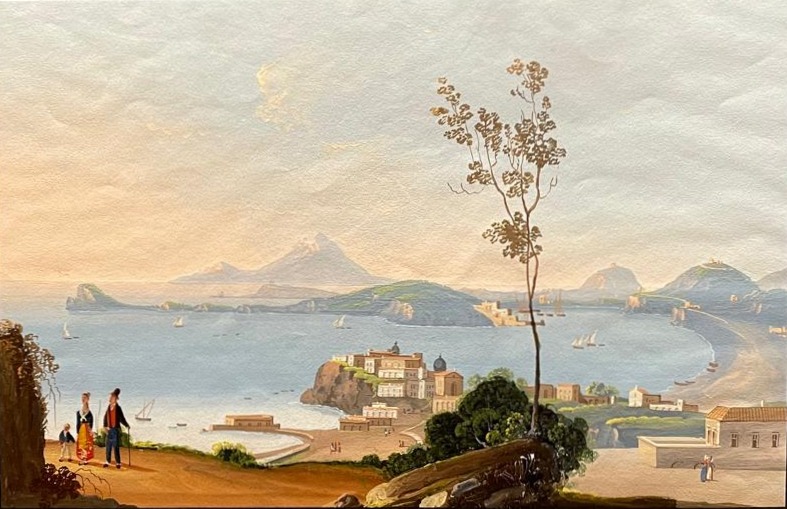
Between the late eighteenth century and the nineteenth, Naples was an essential stop on the Grand Tour, the educational journey through Italy undertaken by Europe’s elite. The city’s workshops sold these travellers thousands of views in gouache: the bay, Capri, Posillipo, Pompeii and, above all, Vesuvius, by day or in eruption. Many bear the name of the place written in the lower margin, like this view with the inscription «Golfo di Baia», and most are unsigned. They are original, hand-painted works, often made in series, and today they are collected for their light and their documentary value.
Pastel: powdered colour
Pastels are sticks of almost pure pigment with very little binder. They are applied dry and the colour remains as powder on the fibres of the paper, with a velvety, luminous look. Under a magnifier you can see the particles of colour on the ridges of the paper, and sometimes traces of dust on the mount. It is the most fragile technique: a rub or a knock can make the colour fall away. That is why a pastel is never touched, is carried flat and is framed with the glass kept away from the work. There is a fine example in our catalogue: a pastel by Eugène Boudin showing a sailing boat at Honfleur.
Drawing: red chalk, charcoal, pencil and ink
- Red chalk: an earthy red chalk, widely used since the Renaissance for figure and landscape studies. Like this couple beneath the trees by René Seyssaud.
- Charcoal: black, matt and powdery. It smudges easily if it has not been fixed.
- Graphite pencil and coloured pencils: in the case of graphite, a line with a slight metallic sheen.
- Ink: applied with pen or brush, sometimes combined with washes of sepia or diluted ink, as in this drawing by Raoul Dufy for Paul Poiret.
Many works combine techniques: watercolour with touches of gouache for the highlights, pencil drawing with washes, red chalk with sepia. A good description says so.
Original or reproduction?
The simplest test is a magnifier. A printed reproduction shows a pattern of regular dots in the areas of colour. In an original you will see brushstrokes, pigment within the fibres, pencil lines beneath the watercolour, pastel dust or the groove left by a pen. Also look at the paper against the light and at the back: remains of old mounts, inscriptions or collectors’ stamps. If you are unsure whether you have an original drawing or a hand-coloured print, our guides to antique prints and antique maps explain how to recognise the trace left by each printing technique.
How to care for works on paper
- Light: watercolour and gouache fade in sunlight. Hang them away from windows and, if possible, behind UV-filtering glass.
- Conservation mount: acid-free, so that the work does not touch the glass and the board does not yellow the paper.
- Damp: avoid cold walls and bathrooms. Humidity encourages foxing and mould.
- No adhesive tape: neither to fix the work in place nor to repair tears. Works are mounted with Japanese paper hinges.
Frequently asked questions
What is the difference between gouache and watercolour?
Watercolour is transparent and lets the paper show through. Gouache is opaque and covers. In a watercolour the whites are the paper; in a gouache, the whites are painted.
Can a watercolour or a pastel be cleaned?
Not at home. Any moisture or rubbing damages them. Stains, tears or mould should be dealt with by a paper conservator.
Is a work on paper worth less than an oil painting?
By the same artist, usually yes. That is why works on paper are a good way to own original work by well-known painters at more accessible prices.
Works on paper in the catalogue
Nineteenth-century Neapolitan gouaches, watercolours, pastels and drawings in red chalk, ink and pencil by signed artists, with dimensions and technique on every listing.
See paintings and drawings →Explore the catalogue
Related pieces

19th Century Gouache with View of the Bay and Capri
Art & Paintings
19th Century
Gouache on paper
Ladrón de Guevara Fine Arts · Madrid
980 €
19th Century Gouache Painting by Rosa Corelli of Vesuvius
Art & Paintings
19th Century · Italy
Gouache on paper
Ladrón de Guevara Fine Arts · Madrid
1.600 €
Pastel by Eugène Louis Boudin from the 19th Century – Sailing Boat at Honfleur
Art & Paintings
19th Century · Honfleur, Francia
Pastel on paper
Ladrón de Guevara Fine Arts · Madrid
15.000 €
Watercolor by Victor Forabosco from the 19th Century – Design of a Greek Temple
Art & Paintings
19th Century · Hannover, Alemania
Watercolor on paper
Ladrón de Guevara Fine Arts · Madrid
9.800 €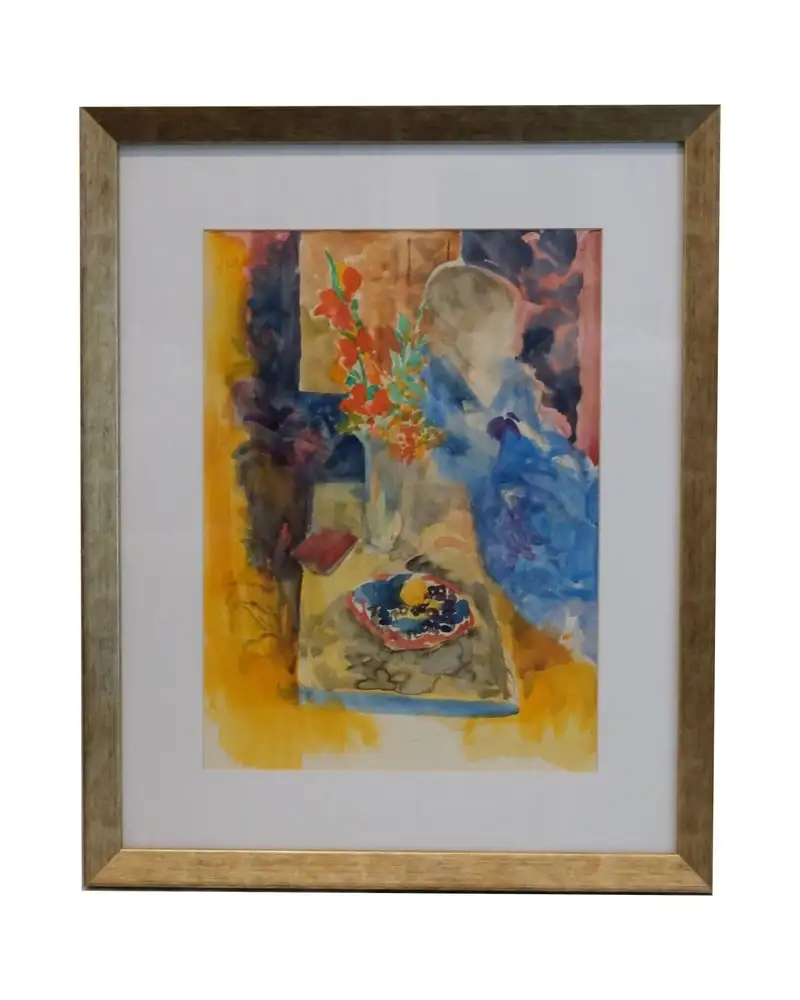
Watercolor, 20th Century
Art & Paintings
20th Century
Watercolor on paper
El Rincón de Viriato · Madrid
550 €
Drawing by René Seyssaud from the 20th Century – Couple under Trees
Art & Paintings
20th Century · France
Red chalk on paper
Ladrón de Guevara Fine Arts · Madrid
2.500 €
19th Century Neapolitan Architecture Drawing with Vesuvius
Art & Paintings
19th Century
Sanguine and sepia on paper
Ladrón de Guevara Fine Arts · Madrid
880 €
Fashion Drawing by Raoul Dufy for Paul Poiret ca. 1917
Art & Paintings
20th Century · France
Ink and Indian ink on paper
Ladrón de Guevara Fine Arts · Madrid
5.800 €