
Authentication
Gallé, Daum and Loetz: how to recognise an original Art Nouveau glass vase
Signatures, cameo technique, iridescence, the pontil mark and wear on the base: how to tell a Gallé, Daum, Loetz or Schneider vase from a modern reproduction, and why so many authentic Bohemian pieces are unsigned.
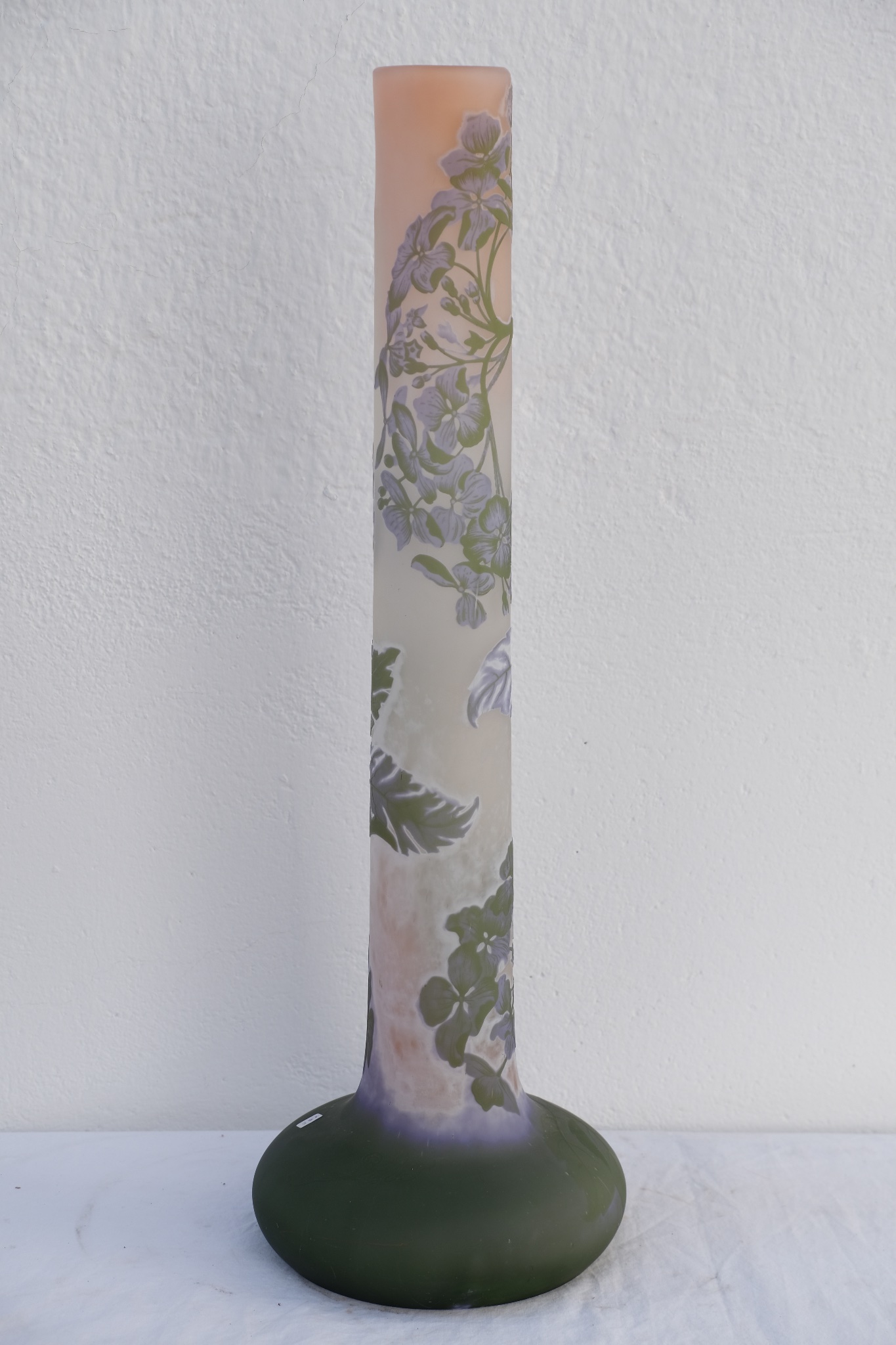
Between 1890 and 1930, art glass enjoyed one of its finest periods. In Nancy, Émile Gallé and the Daum brothers turned the vase into a work of art. In Bohemia, Loetz and its neighbours filled Europe with iridescent glass. And in the 1920s, Schneider and other French houses brought colour to Art Deco. Their success comes at a price: few names have been copied so often. These are the keys to looking at a vase with a discerning eye.
Gallé: cameo glass and an integrated signature
Émile Gallé (1846–1904) worked in Nancy and was one of the central figures of the Nancy School. His best-known technique is cameo glass: several layers of coloured glass laid one over another, in which the decoration — almost always flowers, landscapes or insects — is created by removing part of the layers with acid and, in the finest pieces, by wheel-carving them. Run your finger over it and you can feel the relief of each layer.
After his death in 1904, the workshop carried on producing until 1936. For a time, pieces bore a small star beside the signature as a sign of mourning. Most Gallé vases that reach the market come from this acid-etched series production; they are authentic and sought-after pieces, though less so than the unique works from the founder’s lifetime.
- The signature is part of the decoration: on genuine cameo glass, the signature stands in relief, made with the same layers and the same acid as the design. A signature engraved with a diamond point on a generic decoration is cause for suspicion.
- Modern reproductions: since the 1990s, Gallé-style vases have been made in Romania, signed “Gallé” and often with the word “Tip” next to the signature, which is sometimes removed so they can be sold as antique. Their relief is flatter, the acid work more uniform and the colours more garish.
- Thickness and weight: period pieces have thick walls and are heavy. Many copies are lighter.
Daum: the Cross of Lorraine
The Daum glassworks, also in Nancy, developed its own artistic production from the 1890s under the direction of the brothers Auguste and Antonin Daum. It worked in acid-etched cameo, enamels and colour inclusions within the body of the glass. Its most common signature is “Daum Nancy” accompanied by the Cross of Lorraine. The company is still active, so antique pieces must be distinguished from modern ones, which are signed differently and are often in pâte de cristal or clear crystal in contemporary shapes.
Loetz and Bohemian iridescent glass
The Loetz glassworks, in Klostermühle (Bohemia, now the Czech Republic), won international fame around 1900 with its iridescent glass, with shimmering metallic reflections. Most of its pieces are unsigned. Some, especially those intended for export, are engraved “Loetz Austria”. That is why attribution is based on shape, colour and type of decoration, compared against the factory’s catalogues and documented designs.
Other Bohemian glassworks of the same period, such as Pallme-König, Kralik or Rindskopf, made similar iridescent glass, also almost always unsigned. That is why you often see cautious descriptions such as “Loetz or Kralik”: it is an honest way of describing a piece whose factory cannot be confirmed. Be wary of a Loetz signature on glass that looks new, and of iridescence that seems to be a surface coating: in period glass, the iridescence is part of the glass itself and does not rub off.
Schneider and Art Deco glass
The Cristallerie Schneider, near Paris, produced vases in intense colours in the 1920s, with acid-etched decoration or hot-applied elements. Its commercial lines were signed “Le Verre Français” and “Charder”, a contraction of Charles Schneider. Pieces by Degué or from the Muller Frères workshops in Lunéville date from the same period. Two examples from the catalogue: a vase signed Le Verre Français and another signed Charder.
What the base tells you
Turn the vase over. The base tells you a great deal:
- The pontil mark: in blown glass, the rod that held the piece leaves a scar on the base, often polished. Its presence indicates hand-blowing, although many modern handmade pieces have one too.
- Wear: a century of use leaves fine scratches running in every direction, concentrated on the ring that touches the table. Parallel, uniform scratches, as if from sandpaper, are usually artificial ageing.
- Labels and numbers: some pieces retain shop labels or model numbers. They help to document them, but they can be added, so they are never sufficient proof.
Common restorations
Check the rim with your fingertip: a rim that is lower than usual or slightly asymmetrical may indicate that it has been ground down to remove a chip. Look out for holes drilled in the base too, because many vases were converted into lamps. These are not hidden defects if the seller declares them, but they do affect the price. An example of transparency: the listing for this Bakalowits vase states that it has been restored.
Quick checklist before you buy
- Ask for close-up photos of the signature in raking light.
- Check that the signature is part of the decoration or made with the technique of the period.
- Ask for a photo of the base: pontil and wear.
- Ask for the height and weight, and compare them with documented models.
- Check the rim, drilled holes and declared restorations.
- Be wary of very low prices for very well-known names.
Frequently asked questions
Can an unsigned Loetz vase be authentic?
Yes, and that is the most common case. Most Loetz pieces were not signed. Attribution is made on the basis of shape, colour and decoration.
What does a star beside the Gallé signature mean?
It is associated with pieces made shortly after Émile Gallé’s death in 1904. It does not detract from authenticity: they are pieces from the same workshop.
How do you clean an antique glass vase?
By hand, with lukewarm water and mild soap, and dried with a soft cloth. Never in the dishwasher, and never with sudden changes in temperature. On pieces with metal mounts, clean the glass without wetting the mount.
Art Nouveau and Art Deco glass in the catalogue
Vases by Gallé, iridescent glass by Loetz and other Bohemian houses, Schneider and Degué. You can ask the seller for photos of the signature and the base before buying.
View antique glass and ceramics →Explore the catalogue
Related pieces

Onion Model Glass Vase 1900 Emile Gallé
Decorative Objects
First half of the 20th Century · France
Glass
Mercedes Cabeza de Vaca · Madrid
3.600 €
Yellow Glass Vase by Gallé
Decorative Objects
19th Century · France
Glass
Mercedes Cabeza de Vaca · Madrid
4.000 €
Iridescent Green Glass Vases Loetz 1900
Decorative Objects
Austria
Glass
Mercedes Cabeza de Vaca · Madrid
700 €
Loetz Crystal Plate 20th Century
Decorative Objects
19th–20th Century · Austria
Glass
Mercedes Cabeza de Vaca · Madrid
1.400 €
Art Deco Glass Vase by Charles Schneider
Decorative Objects
First half of the 20th Century · France
Ceramic
Mercedes Cabeza de Vaca · Madrid
2.500 €
Art Deco Glass Vase Schneider
Decorative Objects
20th Century · France
Glass
Mercedes Cabeza de Vaca · Madrid
2.500 €
Small Iridescent White Glass Vase Pallme König
Decorative Objects
First half of the 20th Century · Austria
Glass
Mercedes Cabeza de Vaca · Madrid
360 €
French Glass Vase from the 20th Century Muller or Daum Workshop
Decorative Objects
First half of the 20th Century · France
Glass, metal
Mercedes Cabeza de Vaca · Madrid
2.000 €