
Authentication
Thonet chair: how to tell an original from a reproduction
A guide to identifying authentic Thonet chairs: marks, labels, stamps, the most valuable models (No. 14, No. 18, B9), price ranges and the differences that give reproductions away.
The Thonet chair is probably the most produced piece of furniture in history: the No. 14 model alone has sold more than 50 million units since 1859. That same ubiquity makes it a minefield for buyers, because reproductions — some excellent, many mediocre — far outnumber the originals in circulation. Identifying an original Thonet means knowing the factory marks, understanding how the company evolved and, above all, knowing how to look at the wood.
Browse antique chairs
See the antique chairs and seating published on Antiga, with photos of every detail and the dealer who offers it.
See chairs and seating →A brief history of the original Thonet chair
Michael Thonet (1796–1871), a German cabinetmaker settled in Vienna, patented in 1856 the process of bending solid beech with steam, a technical advance that transformed the furniture industry. His company, Gebrüder Thonet, opened factories in Moravia (today’s Czech Republic) — mainly in Koritschan (Koryčany) and Bystřice pod Hostýnem — where beech was plentiful and labour was cheap. By 1900 the company was producing 4,000 pieces a day.
After the Second World War, the Czech factories were nationalised and since 1953 they have operated as TON (Továrna Ohýbaného Nábytku), while the Thonet brand continued in Germany (Frankenberg). Both companies are still active today, which complicates identification: a TON chair from the 1950s is a legitimate piece made in the same factory as the original Thonets, but it is not a “Thonet” in the strict sense.
Marks and stamps that confirm authenticity
Original Thonet chairs may carry different kinds of marks depending on when they were made:
- Paper label (c. 1860–1900): the oldest chairs carry a paper label glued under the seat with the company’s emblem, the text “Gebrüder Thonet Wien” and sometimes the model number. These labels rarely survive intact.
- Branded stamp (c. 1880–1920): the word “THONET” burnt into the wood, usually under the seat or inside the seat ring. It is the most reliable mark.
- Oval stamp with star (c. 1920–1940): a printed stamp with the Thonet name inside an oval, sometimes with a five-pointed star.
- Metal label (various periods): small brass or aluminium plates screwed to the frame.
- TON mark (after 1953): chairs made in the former Czech factories carry the TON mark, not Thonet.
The most valuable models
- No. 14 (today’s model 214): the Thonet chair par excellence. Designed in 1859, it consists of just six pieces of bentwood, ten screws and two nuts. Nineteenth-century examples with their original label reach €800–2,000; twentieth-century ones, €200–600.
- No. 18: a variant of No. 14 with a taller back and an extra decorative hoop. Slightly rarer and more sought after: €300–800 for twentieth-century examples.
- Rocking chair No. 1 (model 7014): the iconic rocker with continuous beech curves. Nineteenth-century examples, €1,500–4,000; twentieth-century, €400–1,200.
- B9 (No. 209): the bentwood armchair Le Corbusier chose for his interiors and his 1925 pavilion, which is why it is often called the “Le Corbusier chair”. Old marked examples are highly sought after. It should not be confused with the tubular-steel furniture by Le Corbusier, Charlotte Perriand and Pierre Jeanneret that Thonet produced around 1930, which are design pieces with a market of their own.
- Armchair No. 6009: an armchair with a cane seat. Examples from before 1920 are much sought after: €600–1,500.
How reproductions give themselves away
Reproductions of Thonet chairs have been plentiful since the late nineteenth century, when the original patent expired. There were also manufacturers in other countries, Spain included, that produced their own versions. The signs that give a reproduction away are:
- The wood: original Thonets are made of European beech (Fagus sylvatica), steam-bent in a single piece. Reproductions often use laminated wood (glued layers), which can be spotted by examining the edges and the points of greatest curvature.
- The joints: on an original Thonet the curves are continuous and organic. On copies the joints are more obvious, with small steps or breaks in the grain.
- The seat: original seats are hand-woven cane or pressed plywood with an embossed pattern. Plastic cane or glued fabric seats are later or reproductions.
- The weight: an original No. 14 weighs around 3 kg. Reproductions in heavier woods or laminates are usually noticeably heavier.
- The screws: nineteenth-century screws are forged, with a rounded head and a single slot. Phillips (cross-head) screws did not appear until the 1930s.
The Thonet market today
Interest in Thonet chairs has held steady for decades, driven by interior designers who value their versatility: a No. 14 works as well in a rustic dining room as in a minimalist loft. Prices have risen moderately, by around 3–5% a year for nineteenth-century pieces in good condition. Designer models (Le Corbusier, Breuer, Hoffmann) behave like signed design pieces, and their prices follow a different logic, closer to the art market.
Le Corbusier called the No. 14 chair “the most elegant and aristocratic product of industrial manufacture”. Almost two centuries later, it is still hard to disagree.
Antique chairs and seating on Antiga
Browse the antique chairs, including Thonet models, with photos of their marks and provenance details.
See antique chairs →Pieces of this kind
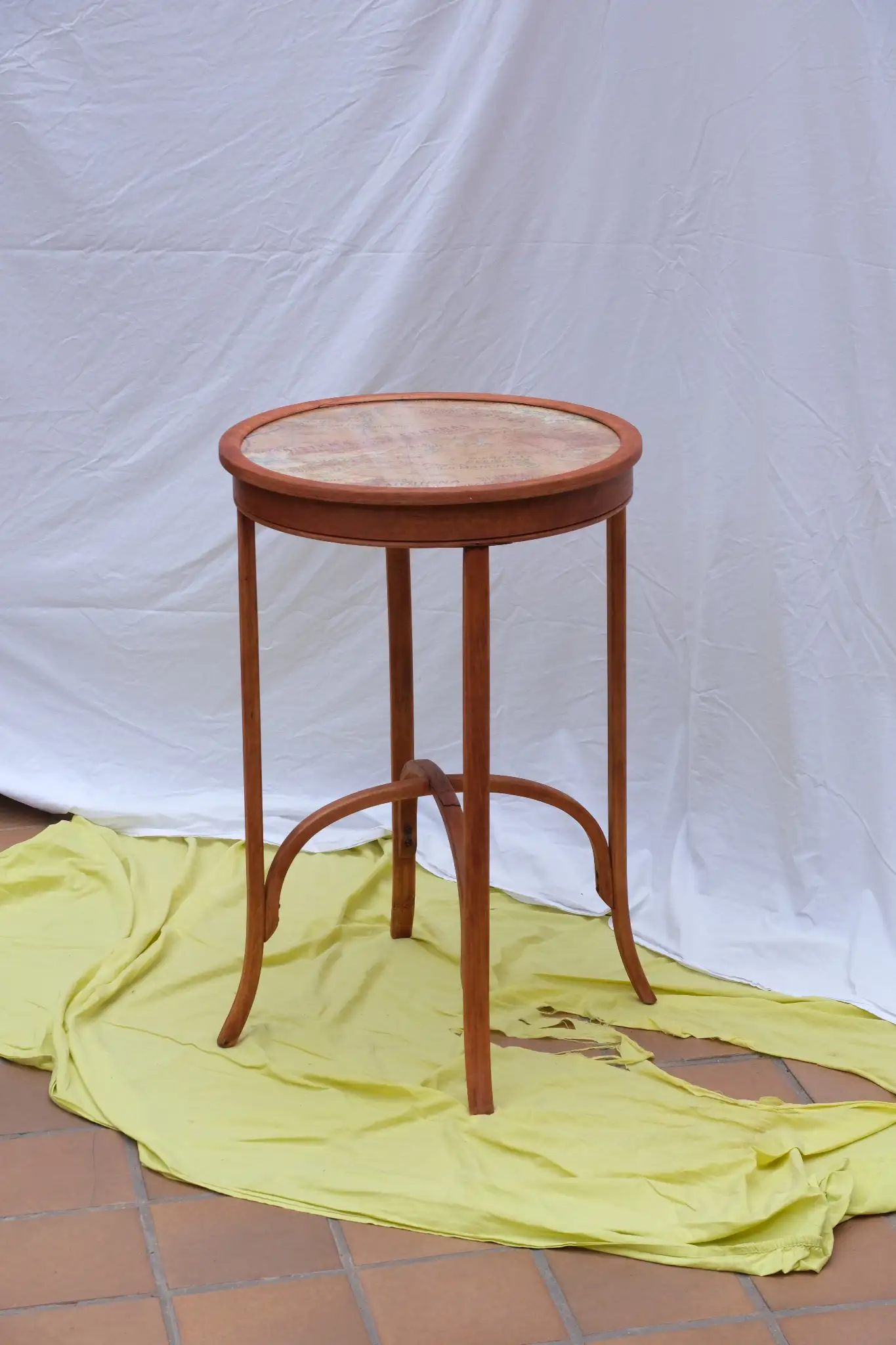
High Table 20th Century Thonet Style
Tables
20th Century · Austria
Beech wood, glass
Mercedes Cabeza de Vaca · Madrid
250 €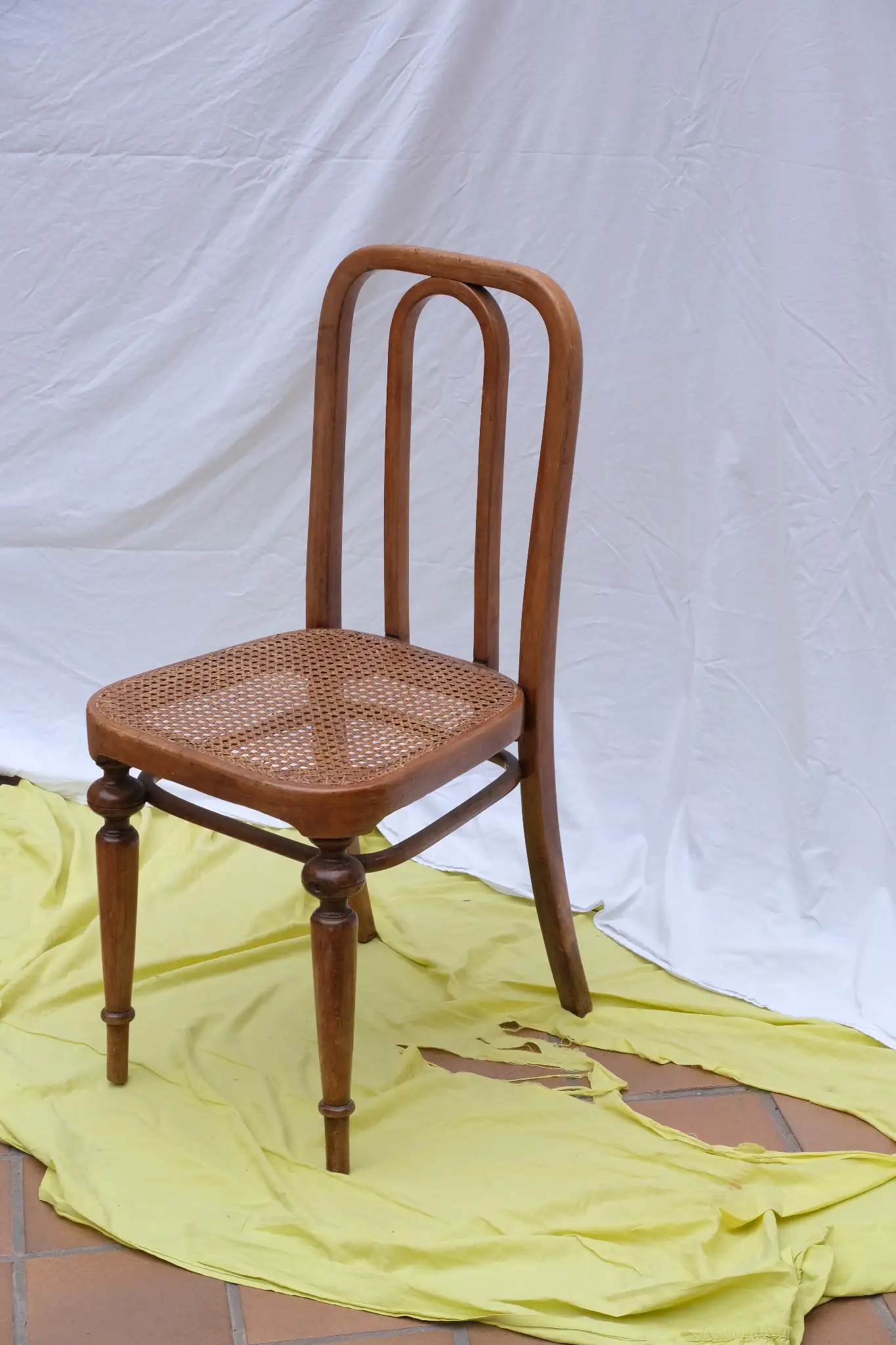
Original Thonet Chair
Chairs & Seating
19th–20th Century · Austria
Beech wood, rattan
Mercedes Cabeza de Vaca · Madrid
200 €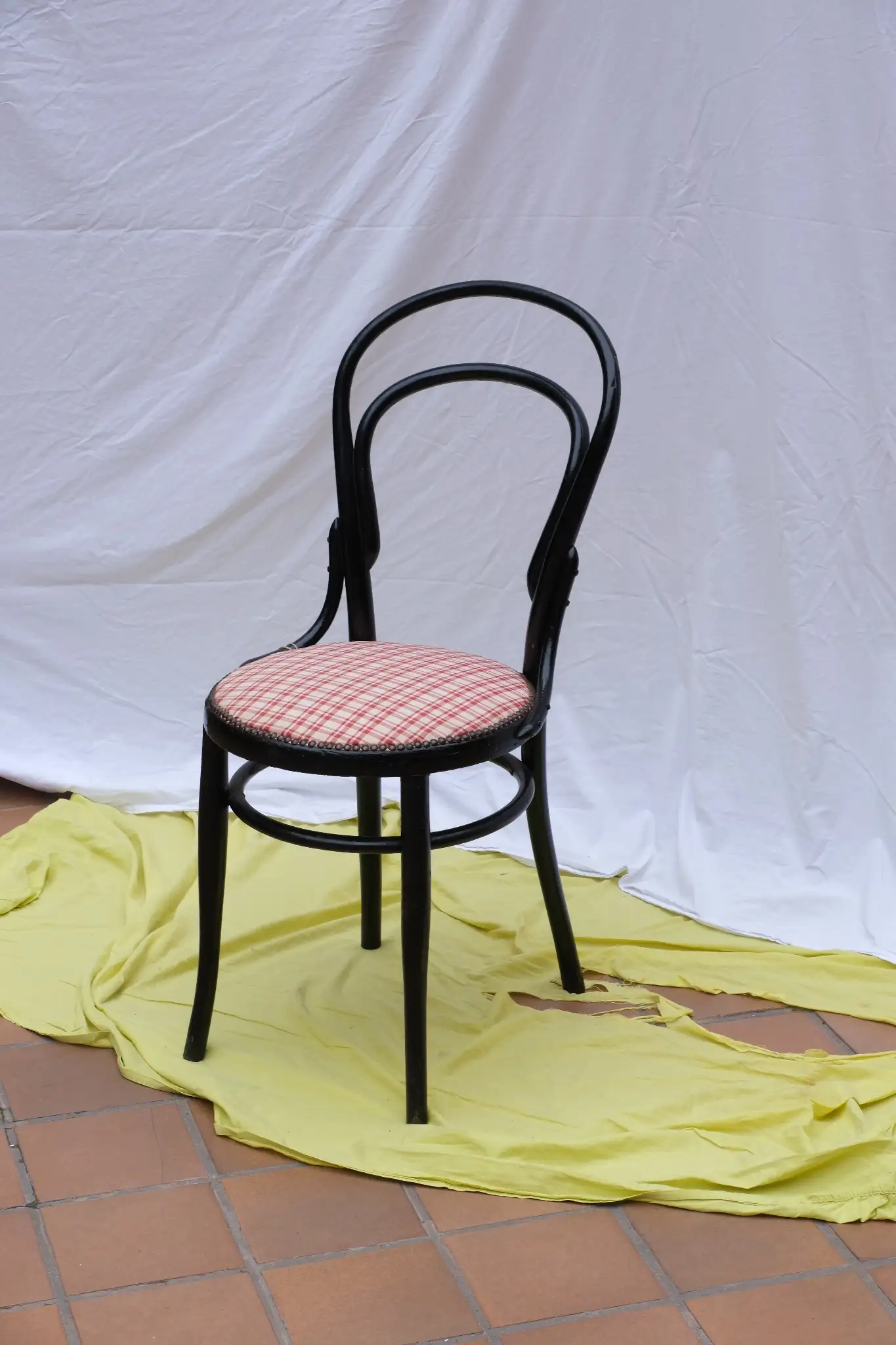
20th Century Thonet Style Chair in Black and Red and White Fabric
Chairs & Seating
20th Century · Tirol, Austria
Wood, fabric
Mercedes Cabeza de Vaca · Madrid
150 €